

Πληροφορίες προϊόντος
The spherical shaped tip design allows for a wide area of contact with the sample. This permits a faster electrode response with a higher degree of stability. The HI11310 utilizes a high temperature (HT) glass formulation. A pH electrode with general purpose (GP) glass will have a resistance of 100 megaohms at 25℃ while the resistance of HT glass is around 400 megaohms at 25℃. As the HI11310 is used at elevated temperatures the resistance decreases to approach the that of GP glass. The HI11310 is suitable to use with samples that measure from -5 to 100℃.
High Temperature Glass Formulation

A pH electrode with general purpose (GP) glass will have a resistance of 100 megaohms at 25℃ while the resistance of HT glass is around 400 megaohms at 25℃. As the HI11310 is used at elevated temperatures the resistance decreases to approach the that of GP glass. The HI11310 is suitable to use with samples that measure from -5 to 100℃.
Spherical Glass Tip
The spherical shaped tip design allows for a wide area of contact with the sample. This permits a faster electrode response with a higher degree of stability. The HI11310 utilizes a high temperature (HT) glass formulation.
Glass Body

The glass body is ideal for laboratory use. The glass is resistant to many harsh chemicals and is easily cleaned. The glass body also allows for a fast transfer of heat to the internal reference electrolyte. The mV generated by the reference cell is temperature dependent. The faster the electrode reaches equilibrium, the steadier the reference potential.
Double Junction Reference

A double junction electrode has an internal compartment surrounding the reference wire. Silver ions are present in the electrolyte of the internal compartment, which houses the Ag/AgCl reference wire; the electrolyte outside this compartment is silver free. The double junction design means that virtually no silver from the electrode enters the sample. This design allows measurement in applications where silver ions in the sample are undesirable or silver precipitates on the junction are likely to form.
Refillable

The HI11310 is a refillable probe. Since it is a double junction pH electrode the fill solution is the HI7082 3.5M KCl. This solution does not contain any silver as with single junction electrode. The absence of silver will prevent any silver precipitate from forming at the junction surface and clogging it. Clogging of the junction will result in drifty and erratic readings.
Built-In Temperature Sensor
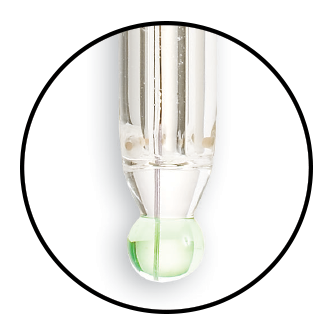
HI11310 features a built-in thermistor temperature sensor that is in the tip of the indicating pH electrode. A thermistor temperature sensor provides for a high accuracy temperature reading and should be as close as possible to the indicating pH electrode in order to compensate for the effect that temperature has on the membrane potential. By having an accurate reading it is possible to provide an accurate temperature compensated reading.
Single Junction Versus Double Junction pH Electrodes

Conventional electrodes are normally single junction. As depicted by the figure above, these electrodes have only a single junction between the internal refernce wire and the external solution. Under adverse conditions, such as high pressure, high temperature, highly acidic or alkaline solutions, the positive flow of the electrolyte through the junction is often reversed resulting in the ingress of sample solution into the reference compartment. If this is left unchecked, the reference electrode can become contaminated, leading to complete electrode failure. Another potential problem with single junction electrodes is the clogging of the junction due to silver chloride (AgCl) precipitation. Silver can be easily precipitate in samples that contain Tris buffer or heavy metals. When the electrolyte solution makes contact with the sample, some AgCl will precipitate on the external face of the junction. The result is drifty readings obtained from the sensor.
Hanna’s double junction system, as the name implies, has two junctions, only one of which is in contact with the sample as shown in the figure. Under adverse conditions, the same tendency of sample ingress is evident. However, as the reference electrode system is separated physically from the intermediate electrolyte area, the contamination of the electrode is minimized. The likelihood of clogging of the junction is also reduced with a double junction electrode since the outer reference cell uses a fill solution that is “silver-free”. Since there is no silver present, there is no precipitate that can form to clog the junction.


